What Do You Need to Participate in a Farmers Market? Complete Vendor Checklist (2026)
Everything you need to set up and run a successful farmers market booth — from permits and canopies to POS systems and customer tracking tools.

Andrew Lund
Co-founder of Misto
What Do You Need to Participate in a Farmers Market? The Complete Vendor Checklist
So you've decided to sell at a farmers market. You've got your product, you've picked your market, and you're excited to get started.
Then the reality hits: what do you actually need to show up and run a successful booth?
After running multiple farmers market businesses and talking to hundreds of market vendors, I've put together the definitive checklist of everything you need, from the basics that every vendor needs on day one to the tools that separate struggling vendors from thriving ones.
Let's break it down.
The Essentials: What You Need Before Your First Market
These are non-negotiables. You can't show up without these.
1. Permits and Licenses
Before you buy a single piece of equipment, make sure you're legal. Every state and county is different, but most vendors need:
Business license: A basic business operating license from your city or county. Usually $50-100 and straightforward to obtain.
Seller's permit / sales tax permit: Required in most states if you're selling taxable goods. Often free to obtain, but you'll need it to collect and remit sales tax properly.
Food handler's permit (food vendors only): If you're selling anything edible, most states require at least one certified food handler per booth. Courses are usually $15-30 and done online in a few hours.
Cottage food license (if applicable): If you're selling baked goods, jams, or other "cottage foods" made in your home kitchen, you'll need a cottage food permit in most states. Rules vary widely.
Market application approval: This isn't a government permit, but don't forget that the market itself needs to approve you as a vendor. Most markets have applications, fees, and their own requirements.
Pro tip: Call your local county health department and small business office before you do anything else. They can walk you through exactly what you need in your specific area in about 10 minutes.
2. Your Booth Setup
Your booth is your storefront. First impressions matter.
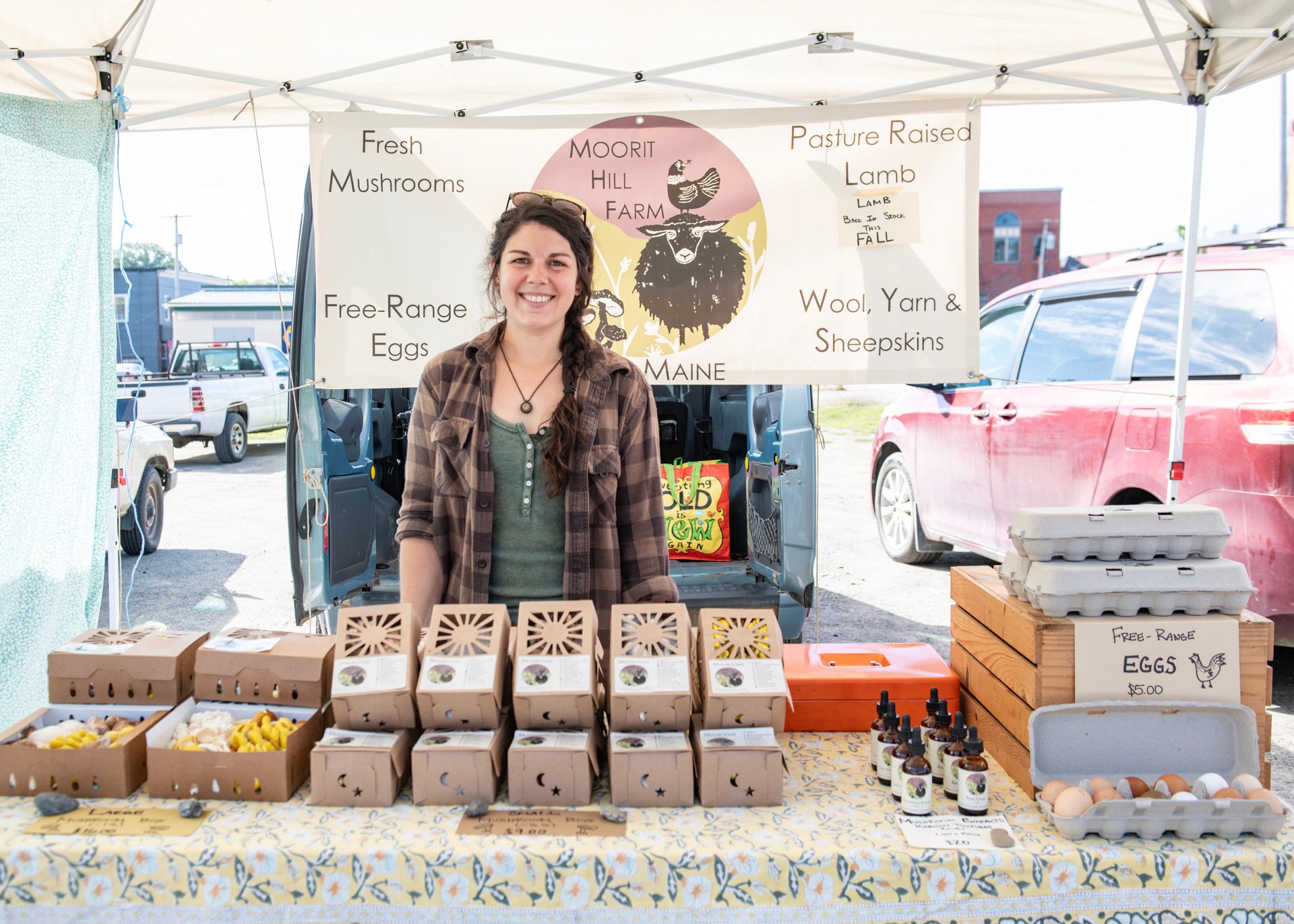
Canopy/Tent (10x10 is standard): The standard farmers market space is 10x10 feet. A quality canopy is one of the most important investments you'll make.
Budget option: Ez-Up Ambassador ($150-200) — works fine to start
Mid-range: Ez-Up Encore ($200-300) — better durability for frequent use
Best quality: Eurmax or Caravan Canopy ($250-400) — worth it if you vend regularly
Look for: Water resistance, UV protection, easy setup/breakdown, and weight under 25 lbs.
Canopy weights: Non-negotiable for safety. Most markets require at least 25 lbs per leg. Options include:
Water-filled weights (cheap, easy to transport empty)
Sandbags ($10-20 each)
Leg weight bags filled with sand ($20-30 each)
Tables: Most vendors use one or two 6-foot folding tables. Look for:
Folding legs for easy transport
Weight capacity of at least 150 lbs
A tablecloth that reaches the ground (hides your storage underneath)
Display risers and shelving: Flat tables don't sell products. You want height variation to catch eyes and fit more product in your footprint. Options include:
Wooden crates (rustic, popular at markets)
Wire shelving units
Tiered display stands
Easels for signage
3. Signage
Customers need to know who you are, what you sell, and what things cost — before they even get to your booth.
Must-have signage:
Banner or backdrop: Your business name, big and readable from 30 feet away. Vistaprint, Canva + local print shop, or Etsy vendors all do great work for $50-150.
Pricing signs: Clear, readable prices for everything. Customers who can't find the price often just walk away rather than asking. Laminate them so they survive rain.
Product labels: Especially important for food vendors — ingredients, allergens, and product names.
Payment methods accepted: More important than ever. A small sign showing the Venmo QR code, Cash App handle, and "Cards Accepted" prevents confusion during the rush.
Pro tip: Use Canva's free plan to design everything and print at a local FedEx or Staples for a fraction of what sign shops charge.
4. Point of Sale System
This is where a lot of new vendors make their first big mistake: they don't think about payments until they're standing at their booth with customers in front of them.
You need to accept:
Credit and debit cards (non-negotiable — you'll lose 20-30% of sales without this)
Tap to pay (Apple Pay, Google Pay — increasingly expected)
Venmo and Cash App (huge at farmers markets, especially with younger buyers)
Cash (still significant, especially at outdoor markets)
Your options:
Square: The most popular choice for new vendors. Easy setup, recognizable brand, decent features. Downsides: 2.6% + $0.10 per transaction, no built-in Venmo tracking, reports aren't designed for event-based selling.
Misto: A POS built specifically for market vendors. Tracks Venmo and Cash App payments in the same place as card payments (no more screenshotting), has event-based reporting so you can see which markets are actually profitable, and lower fees than Square. Built by a food truck owner who got tired of the manual payment reconciliation. Check it out at getmisto.com.
PayPal Zettle: Good if you're already using PayPal. Fees are slightly lower than Square (2.29% + $0.09), but still no Venmo integration.
SumUp: Simple, user-friendly, no monthly fees. Good budget option but limited reporting.
What actually matters in a farmers market POS:
Works on your phone (no bulky hardware to carry)
Has reliable offline mode for markets with bad WiFi
Tracks all payment types in one place
Shows you which markets are your most profitable
5. Cash Box and Change
Even in 2026, cash is alive and well at farmers markets. Come prepared.
Starting change: Bring at least $100 in small bills — a mix of $20s, $10s, $5s, and $1s. The number of people who show up to a market with a $100 bill is astonishing.
Cash box or apron: Keep cash secure and organized. A basic cash box with a lock ($20-30) works great, or a vendor apron with pockets keeps your hands free.
End-of-day reconciliation: Count your starting cash, add your sales, subtract ending cash = what you should have taken in. Do this every market without exception.
Level 2: Tools That Make You More Efficient
You can technically vend without these, but you'll be working harder than you need to.
6. Inventory Management System
Walking up to a market without knowing your inventory is a recipe for lost sales and waste.
At minimum, track:
How much product you brought
How much you sold
How much you brought home
Over 10 markets, patterns will emerge. You'll know that rainy Saturdays at Market A mean bring 30% less, and summer festivals mean double your inventory.
Simple options:
A basic spreadsheet (Google Sheets is free and works on your phone)
Notes app on your phone
A POS system that tracks inventory automatically (look for this when choosing your POS)
What to track per market:
Date and market name
Weather
Foot traffic (your estimate: low/medium/high)
Starting inventory by product
Ending inventory by product
What sold out vs. what came home
7. Marketing Tools for Keeping Track of Customers
One of the biggest missed opportunities for market vendors is letting customers walk away with no way to reach them again.
Your customers are standing right in front of you. They already like what you make. Getting them to come back — or to seek you out at a different market — is 10x easier than finding new customers.
Build your customer list with:
Text message list: The highest open rate of any marketing channel (98%). A simple sign: "Text JOIN to [number] to get our market schedule and exclusive deals." Tools like SimpleTexting or EZTexting make this easy ($25-50/month for small lists).
Email list: Lower engagement than text, but great for longer updates. Mailchimp is free up to 500 contacts. Have a sign-up sheet or QR code at your booth.
QR code to your social media: A simple QR code linked to your Instagram or Facebook page. Customers scan it, follow you, and you've got a way to reach them. Print it on a small card or sign.
Venmo / Cash App connection: Every customer who pays you via Venmo is now in your network. They can find you again easily, and you can see their name.
Pro tip: Offer a small incentive to join your list. "Text JOIN to [number] and get 10% off your next purchase" doubles sign-up rates.
8. Product Photography and Social Media Presence
Customers research vendors before markets. They check Instagram. They look you up. If they can't find you, or if your photos don't look appetizing/appealing, you're losing sales before you even set up.
You need:
An Instagram or Facebook page for your business
10-15 good photos of your products (natural light, clean backgrounds)
Your market schedule posted and up to date
You don't need:
Professional photography (your phone is fine with good lighting)
A huge following (even 200 followers is enough for social proof)
Daily posting (consistency matters more than frequency)
Free tools:
Canva: Design graphics, promotional posts, and signage. Free plan is excellent.
Later or Buffer: Schedule posts in advance so you're not trying to post from a crowded market. Free plans available.
Google Business Profile: Free listing that shows up when people search "[your business] farmers market." Takes 10 minutes to set up.
9. Packaging and Bags
Often overlooked until you're standing at your booth handing a customer a purchase with nothing to put it in.
Consider:
Branded bags or tissue paper (small touch, big impression)
Business cards or sticker with your social media handle
Packaging that travels well (customers are walking around, not going straight to their car)
Branded packaging doesn't have to be expensive: A simple sticker with your logo on a plain kraft bag looks great and costs pennies per unit.
Level 3: Tools That Separate the Best Vendors From Everyone Else
10. Weather and Market Analysis System
The best vendors I know treat their business like a data problem. They track weather vs. sales, foot traffic patterns, and profitability by event type.
Simple version: A spreadsheet with: Date | Market | Weather | Temp | Foot traffic | Revenue | Vendor fee | Net profit
After 20-30 markets, you'll see clear patterns:
Which markets are most profitable per hour
What weather conditions tank your sales
Which seasons are worth adding extra markets
When to skip a market and stay home
This is one of the most valuable things you can do as a vendor and almost nobody does it systematically.
11. A Reliable Vehicle Setup
Your vehicle is part of your business. Getting stranded, being late to setup, or not having enough space costs you money.
Think through:
Can you fit your full setup without unloading and reloading every time?
Is your vehicle reliable enough that a breakdown won't ruin a market day?
Do you have a system for loading/unloading quickly? (Load in reverse order: last things in are first things out)
Cargo organization:
Use labeled bins for each station (booth structure, display, POS, product)
Store frequently accessed items toward the back
Keep a "go bag" with essentials (change, phone charger, hand sanitizer, basic first aid, snacks for yourself)
12. Professional Development and Vendor Community
The vendors who grow fastest aren't doing it alone. They're learning from other vendors, sharing what works, and staying plugged into the community.
Resources:
Vendor Facebook groups: Farmers market vendor groups, food truck groups, and craft vendor communities are full of practical advice. Search for your state or region. One especially beneficial one is https://www.facebook.com/groups/marketvendorhub
Your market's vendor communication: Stay plugged in to whatever communication channel the market uses. Market organizers often have tips, early heads-ups on prime spaces, and opportunities for returning vendors.
Other vendors at your market: Your fellow vendors aren't just competition — they're your best source of advice on what's working, which markets are worth trying, and how to navigate local regulations.
The Quick-Start Checklist
Before your first market:
[ ] Business license
[ ] Seller's permit / sales tax permit
[ ] Food handler's permit (if applicable)
[ ] Market application approved
[ ] 10x10 canopy + weights
[ ] Tables + tablecloth
[ ] Signage (business name, pricing, payment methods)
[ ] POS system set up and tested
[ ] $100 starting change
[ ] Cash box or vendor apron
[ ] Packaging and bags
[ ] Product inventory counted and logged
In your first 3 months:
[ ] Inventory tracking spreadsheet
[ ] Social media page with good product photos
[ ] Customer list / text sign-up system
[ ] Market performance tracking spreadsheet
Once you're established:
[ ] Branded packaging
[ ] Scheduled social media content
[ ] Email list
[ ] Clear data on which markets are most profitable
Final Thoughts
The vendors who struggle at farmers markets are usually under-prepared in one of two areas: they either don't have the right setup to look professional, or they don't have systems to understand what's working and grow from it.
The good news is that none of this is complicated. It's just a matter of getting the basics right before day one, then building your systems over the first few months.
If there's one thing I'd prioritize beyond the basics: track everything. What you sold, what you didn't, what the weather was, what worked. Market vendors who treat their booth like a data-driven business outgrow the ones who are just winging it, every single time.
And if you want a POS that does the tracking for you — event-based reporting, Venmo included — [Misto was built for exactly this. Join the waitlist here.]
About the Author Andrew Lund runs Lil Mama's food truck and is the founder of Misto, a POS system built specifically for farmers market vendors, food trucks, and farm stands. After years of screenshotting Venmo payments and manually reconciling sales, they decided to build a better solution.